
 As the debt on the parish was being reduced, thoughtful parishioners began noticing how badly the church needed redecorating. As long as the shadow of the auctioneer's hammer rested on the building, only the most essential repairs had been made. Edward Paine, an interior decorator, had painted the church and had renewed the altars and the pews at a cost of $1,750.00 in the autumn of 1918. In the years that followed, ugly marks had appeared on the ceiling and walls, attesting to the fact the roof had sprung leaks at one time or another. The leaks were stopped, but there had just been no money for new decorations.
The Altar Society, always an active group in the parish, began to collect money to meet the cost of new painting. They sponsored various many-making affairs which brought together the sum of $2,800.00. At the same time, they canvassed the parish and collected almost $2,000.00 more to meet the cost of painting the church, the pews, and the statues. This, together with many additional contributions from the various societies such as the D. of I., the C.Y.C., and individuals, made it possible to engage Mr. Alex Linenberger, a member of the parish and a church decorator, to redecorate St. Joseph's Church. The contract price for the decoration was $4,500.00. The cost of painting the pews was $275.00; and of the statues, confessionals, pulpit, baptismal font and various smaller articles came to $304.50. He and his assistant toiled over and did a job that was very beautiful. The walls and ceiling were given new coats of paint, the pews were refinished, and the statues renewed. All this was done without creating a new debt.
 According to church law, in consecrated churches at least one altar, especially the main altar, must be immovable. An altar of this kind consists of a table of a single slab of natural, solid stone affixed to stone supports. The altar which stood in the church at the time and had served so well for forty years did not fulfill these requirements. Therefore, it was decided to make a change in at least the high altar. But a stone or marble altar is very expensive, and there was no intention of placing another debt on the parish. A parishioner, Mr. A.A. Wiesner, presented a marble high altar to the church. To have one marble altar and two wooden one in the sanctuary would not harmonize. Therefore two other men of the parish, Mr. Joseph Wiesner and Mr. Leo Wiesner, sons of the donor mentioned above, gladly gave the money for the additional two side altars. When the parish heard about this, there was a scramble to give the money necessary for two side altars outside the sanctuary. Since A. A. Wiesner had given the original St. Anthony's altar, he also gave the new St. Anthony's altar and dedicated it to Alfred and Anthony Wiesner families. Mr. Clarence Grabbe paid for the St. Francis altar. So the church now had five altars of marble of which the parish could be justly proud. The wainscots of these altars were of Alabama marble, the basses of Vermont green, and the top slabs of Ozark Tavernelle. The marble crosses and the candle brackets for the walls of the church were a donation of Dr. G.C. Unrein, M.D. All marble was purchased from the Carthage Marble Corporation of Carthage, Missouri. The setter was Mr. Joseph Rausch of Kansas City, Kansas.
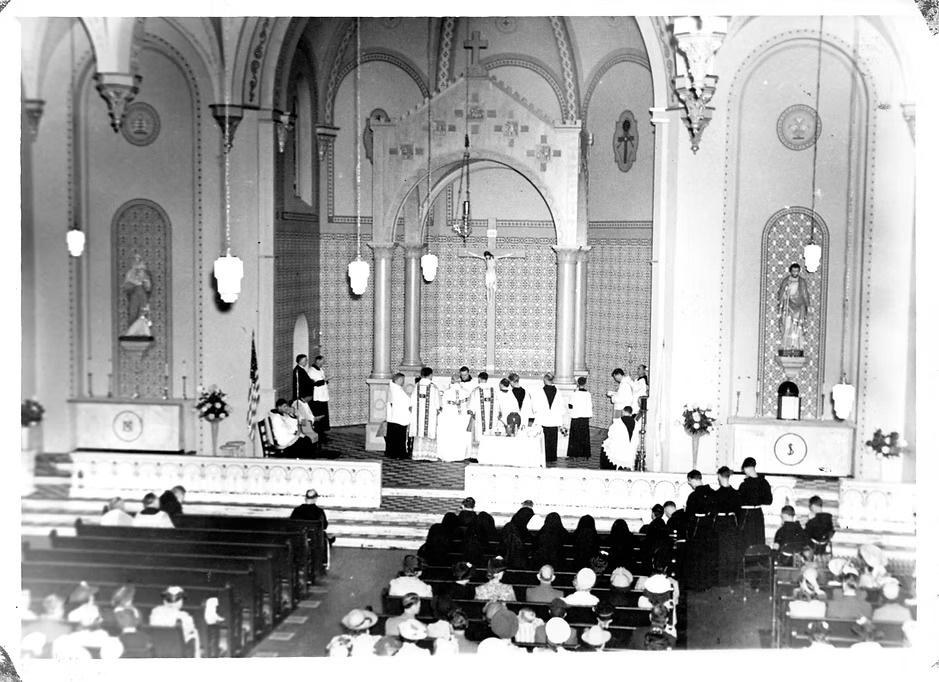
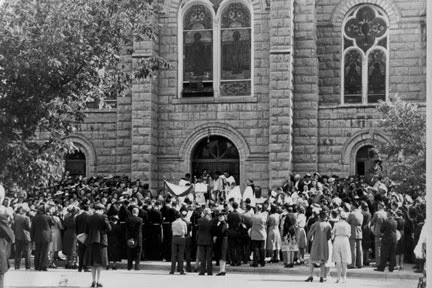
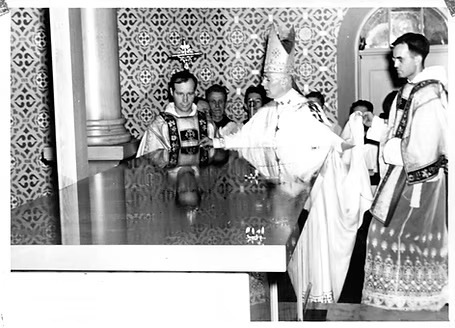
To erect altars of this kind required a very firm support. The weight of the high altar, for instance, was approximately seven tons; that of the top slap alone was 1700 pounds. It was found necessary to build a support in the basement on which the high altar would stand and build supports in the floor of the church for the side altars. Masonry of brick had also to be built to form the core to which the marble was attached. This work was ably undertaken by Mr. John Eberle, a member of the parish. He and his helpers had built a support that should always prove adequate for the weight of the altars. To complete the high altar, it was necessary to erect a canopy or ciborium over it. A ciborium is beyond doubt the most correct manner of covering an altar, and at the same time, by far the most beautiful. The work of constructing this covering for the high altar was given to Mr. Herman Dreiling, a member of the parish and an altar builder of experience. It was decided to build this covering of unfinished oak. After several months of hard work, this beautiful canopy was completed and installed in time for the consecration. Mr. A. A. Wiesner also donated the canopy. Since one of the main ceremonies of the consecration of a church consists in anointing the doors, it was thought proper to install new doors for the occasion. Mr. Peter J. Jacobs, a member of the parish, contributed the money for the doors. They were built by Mr. Herman Dreiling; the hand wrought iron straps and hinges are the work of Mr. George Kubitschek of Salina. The doors were hung by Sigmund Leiker, Mr. Peter Spies, Mr. Joseph Gerstner, and Mr. T.J. Schreiner, all members of the parish. Bishop Frank Thill solemnly consecrated St. Joseph's Church on May 30, 1944.