
Built 1901 - 1904
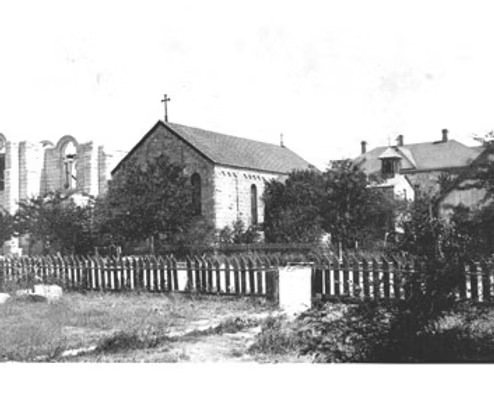 In this photo you can see the new (3rd) St. Joseph Church under construction
to the far left, the first stone church in the middle and the old wooden first church
located to the right of the stone church behind the trees.
In 1887, when the second church was built and consecrated, the official census of the parish showed sixty families. Ten years later, the parish numbered 116 families. The second church, considerably larger than its predecessor, was now becoming too small. A larger church was becoming a necessity. The pastor and people began to make arrangements for the larger church.
Fr. Mark Haas, O.F.M. Cap., the pastor in 1900 engaged Joseph Marshall, a Catholic architect in Topeka, to draw up plans for the new church. These were finished in the spring of 1901. The Rt. Rev. Bishop Cunningham inspected them and, on April 25, 1901, gave permission to make a loan of $10,000.00. On June3, after a solemn Mass in honor of St. Joseph, the pastor and people went in procession to the new location and solemnly broke the ground for the new church. Work was pushed energetically. Forty men finished the excavating in about a week. Work could now begin on the foundation, but the terrific heat, registering at times 110 degrees, put a stop to the labor. Work was resumed later, and the cornerstone was laid November 28, 1901.
The Right Rev. Bishop of Concordia presided at the cornerstone laying. Fifteen priests were present. Rev Rudolph Stollenwer of Liebenthal preached the German sermon. He was followed by Rev. B. Hayden of Solomon, who spoke in English. A great mass of people had gathered for the occasion. The cornerstone is of Vermont granite and was supplied by Hubert Gretten of Beloit. While building operations were in progress, the pastor and people were not idle. Fairs and suppers were held to raise money to meet the cost. Even the Hays Military Band help along! They gave a concert at which articles were “chanced” off. On this occasion, a tidy sum of over $800.00 was realized.
But it was easier to pay out money than to gather it, and building operations were suspended for a time because of lack of money. Permission was granted to make another loan, and building operations resumed. Poor harvests were the cause of the lack of money. Father Mark did not witness the completion of the church. In August, 1903, he was transferred to Dover, Ohio. His place at Hays was taken by Fr. Richard Dei, O.F.M. Cap. Ten days later Rev. Bishop solemnly blessed the new bells. At this time the exterior of the church was completed. Plastering was not undertaken until March, 1904, and the work dragged on slowly because of the rather unskilled labor at the disposal of the pastor. Finally, in June, 1904, the church was completed dedicated.
Dedication day was June 12, 1904. So many people flocked to Hays from all directions that the church was not large enough to hold them all. The Rt. Rev. John F. Cunningham, D. D. Bishop of Concordia, himself conducted the services. Following the Roman Ritual closely, the bishop blessed the walls inside and out, after which the Litany of the Saints was chanted solemnly. Only then were the church doors open to the faithful. At the Gospel, the Rev. John Maher of Salina preached an inspiring sermon in English. After communion, the Very Rev. Hyacinth Epp, O.F.M. Cap., founder of the Capuchin Province of St. Augustine, delivered an eloquent sermon in German. The afternoon was given to general rejoicing. The day was brought to a fitting close as solemn Vespers were conducted by Father Maher, assisted by Frs. Celestine and Richard.
All the usable furniture was transferred from the old church. New pews were purchased for $576.76 from the Catholic School Supply Co., Milwaukee, in November, 1904. The Stations of the Cross were canonically erected the next year. Owing to the lack of funds no heating facilities were put into the church at first. The winter from 1904-1905 was an exceptionally hard one. Only the essential services could be held in the church. When the winter was almost over the steam heat fixtures arrived and they were installed in March, 1905.
The high altar in the church was a donation of Mrs. Mary Murphy Morrell. The side altars, set up in November 1904, were also donations. The Sacred Heart altar with its statue was a donation of Mr. and Mrs. Harvey Penny and Mrs. Magrane. The Blessed Mother's altar with its statue was the gift of the John Schlyer family. The following year the altars in the transept were donated. Mr. Jacob Brull gave one altar with the statue of the Sorrowful Mother, Mr. A.A. Wiesner gave the St. Anthony altar. The statue of St. Anthony was a donation of John Miller of St. Joseph, Missouri. Altar and wall brackets for the sanctuary were a donation of John Gross, Jose Basgall, Peter Staab Jr., and John Schlyer. In 1908, Miss Haffameier and Mrs. Jordan gave the chandeliers. In the same year, more pews had to be set up to take care of the growing congregation. In November, 1917, work was begun by Edward Paine to paint the church. The job was completed in February, 1918. The decorating cost $1,400.00. The renovation of the altars cost $75.00 and painting of the pews cost another $300.00. The church was now a worthy house of God.
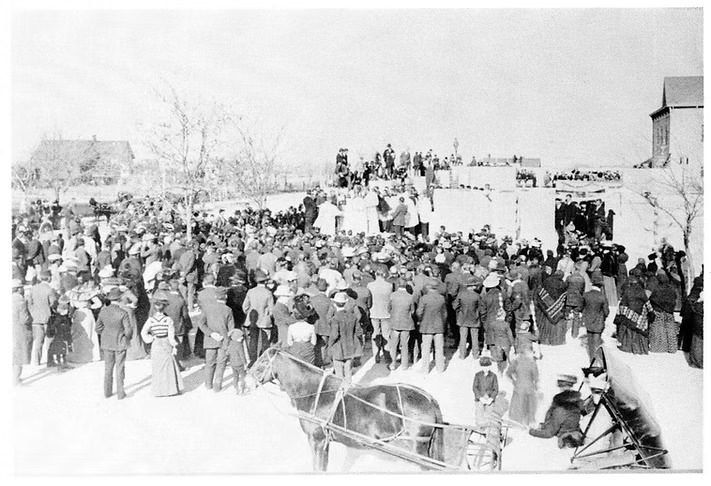
Above is a photo of the laying of the cornerstone of the St. Joseph Church in 1901.